Understanding PAGA Systems in Oil & Gas: A Practical Guide
Walk into any major refinery in the UAE and you'll notice industrial speakers positioned throughout the facility. These aren't ordinary public address systems—they form the critical backbone of safety communication in high-risk environments.
Public Address and General Alarm systems, commonly known as PAGA, serve two distinct functions. During normal operations, they broadcast routine messages across different areas of a facility. When emergencies occur, they transform into life-saving alert systems that must cut through industrial noise to deliver evacuation instructions.
Why Standard PA Systems Fall Short
Processing plants present unique acoustic challenges. Compressors, turbines, and pumps generate continuous background noise reaching 90 to 110 decibels. Standard commercial speakers simply cannot deliver clear speech in these conditions.
The metric used to measure voice clarity is called Speech Transmission Index, ranging from 0 to 1. Safety regulations typically require a minimum STI of 0.5 for emergency announcements. Achieving this in extremely noisy industrial settings demands specialized equipment and careful engineering.
Environmental factors add another layer of complexity. Summer temperatures in Gulf countries regularly exceed 50 degrees Celsius. Equipment faces intense UV exposure, humidity, dust storms, and occasional rain. Offshore platforms must withstand salt spray and constant moisture. Components need appropriate ingress protection ratings—IP66 minimum for most outdoor installations.
The most critical consideration involves explosion risks. Hydrocarbon processing creates potentially explosive atmospheres. International standards classify hazardous areas into zones based on ignition probability. Zone 0 indicates continuous presence of explosive gas. Zone 1 means explosive atmospheres likely occur during normal operation. Zone 2 suggests brief or unlikely occurrence.
Every component installed in hazardous zones requires certification proving it won't ignite flammable gases. ATEX certification applies in Europe while IECEx covers international markets. Non-certified equipment in hazardous areas creates serious legal liability and genuine safety risks.
System Architecture and Components
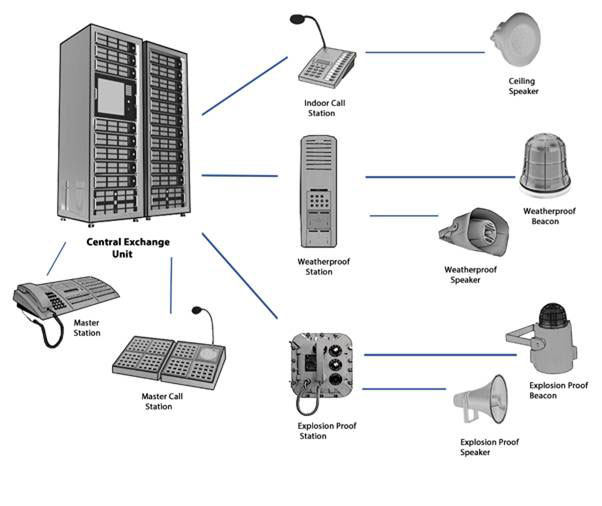
Central control stations typically reside in main control rooms. Modern implementations use industrial-grade servers with redundant power and network connections. Operators see real-time status of all zones, can select pre-recorded emergency messages, and monitor system health through intuitive interfaces.
Zone amplifiers distribute throughout facilities, with each process unit or building forming a separate zone. Amplifier capacity ranges from 100 to 500 watts depending on coverage requirements and speaker quantities. Class D digital amplifiers have largely replaced older analog designs due to better efficiency and lower heat generation.
Horn speakers handle long-range coverage in open areas. Their distinctive cone shape projects sound over distances up to 100 meters in favorable conditions. Power ratings typically range from 15 to 50 watts. Stainless steel or aluminum construction withstands harsh environments better than polymer housings.
Column speakers work better for focused coverage along pipe racks, inside buildings, or near control stations. They produce narrower sound dispersion patterns compared to horn designs. This characteristic reduces unwanted noise in adjacent areas while maintaining intelligibility in target zones.
All speakers connect through supervised loops that continuously verify connectivity. When a speaker fails or cables get damaged, the system immediately alerts operators. This supervision capability distinguishes safety-critical systems from commercial installations.
Cable selection matters significantly. Fire-rated cables with appropriate conductor sizes handle both audio signals and power distribution. Calculations must account for voltage drop over long runs. Metal conduit or cable tray protects wiring in areas with mechanical hazard potential.
Integration Requirements
PAGA systems rarely operate in isolation. Fire and gas detection systems trigger automatic emergency announcements based on sensor inputs. Process control systems generate operational notifications. Radio networks enable direct communication between field personnel and control rooms.
The cause-and-effect matrix documents which inputs trigger which announcements in which zones. A gas leak detected in one process unit should evacuate that immediate area while warning adjacent zones. Administrative buildings located at safe distances might not require activation.
Communication protocols vary. Hardwired digital inputs provide the most reliable triggering mechanism. Modbus TCP/IP enables flexible network-based integration. OPC connects to SCADA systems. Critical safety functions often use both hardwired and network paths for redundancy.
Design Considerations
Acoustic modeling software calculates speaker quantities and positions based on coverage requirements. Engineers input facility layout, equipment locations, expected noise levels, and desired performance targets. The software generates speaker placement recommendations accounting for sound propagation, reflections, and absorption.
Background noise measurements must reflect actual operating conditions, not shutdown states. Plants sound dramatically different when processes are running. Designs based on quiet conditions often fail performance tests after startup.
Redundancy prevents single-point failures. Dual amplifiers serve each zone with automatic failover. Battery systems provide 30 to 90 minutes of backup power depending on facility criticality and client requirements. Control servers operate in redundant pairs with continuous synchronization.
Message priority levels ensure emergency announcements override routine broadcasts. Systems typically implement five to seven priority tiers. Higher priority messages automatically interrupt lower priority communications.
Regulatory Framework
IEC 60849, recently redesignated as EN 50849, establishes international requirements for emergency sound systems. This standard specifies minimum STI values, response times, supervision requirements, and fault indication.
NFPA 72 from the National Fire Protection Association applies to facilities designed by American engineering firms or following US codes. This standard contains detailed specifications for speaker spacing and audio performance verification.
Facilities implementing Safety Instrumented Systems may require SIL certification for PAGA equipment. SIL 2 rating involves systematic capability assessment, random hardware failure analysis, and defined proof testing intervals.
UAE regulations include Civil Defense fire safety requirements, SIRA equipment approval in Dubai, and OSHAD occupational safety standards in Abu Dhabi. Major operators like ADNOC publish their own engineering specifications that exceed international minimums.
Common Implementation Issues
Battery capacity calculations sometimes underestimate actual requirements. A 30-minute specification might seem adequate on paper, but major incidents can take hours to resolve. Facilities should consider 60 to 90-minute backup as minimum for critical installations.
Speaker placement often prioritizes acoustic performance while ignoring maintenance accessibility. Speakers mounted in locations requiring scaffolding or special access equipment create ongoing operational challenges. Every speaker should be reachable with standard maintenance platforms or ladders.
Cable documentation frequently receives insufficient attention during construction. Clear labeling using consistent conventions saves countless hours during troubleshooting. As-built drawings must accurately reflect installed conditions, not original design intent.
Testing procedures need careful planning. Full-volume alarm tests disrupt operations and cannot occur frequently. Systems should support low-volume testing, selective zone activation, and automated self-checks that verify functionality without disturbing normal work.
Practical Application Example
Consider a recent offshore platform installation in the Arabian Gulf. The facility houses 120 personnel across living quarters, process areas, drilling operations, and heliport.
Twelve zones divided the platform into logical groupings. Living quarters used three zones for different accommodation levels. Process deck required four zones covering separation, compression, power generation, and utilities. Drilling area split into two zones for rig floor and mud processing. Helideck formed a dedicated zone.
Equipment selection balanced performance against environmental challenges. Stainless steel explosion-proof horn speakers with ATEX Zone 1 certification handled process areas. Marine-grade column speakers served accommodation blocks. Each zone received dual 500-watt amplifiers with automatic failover capability.
Battery systems provided 90 minutes of backup power—longer than typical specifications but justified by offshore evacuation complexity. Central control implemented full redundancy with dual servers and network paths.
Integration included hardwired connections from fire panel zones, Modbus links to gas detection systems, and interfaces to platform radio network. The design passed all performance testing with STI exceeding 0.65 throughout the platform, including measurements during helicopter operations on the helideck.
Maintenance Strategies
Daily automated checks monitor amplifier status, speaker supervision, power supplies, and server health. These checks run automatically without manual intervention.
Weekly tasks include low-volume test announcements to verify audio quality and zone selection accuracy. Integration functionality receives testing when operational conditions permit safe activation.
Monthly inspections cover visual examination of speakers and cables, battery voltage verification, and cleaning of outdoor equipment. Firmware updates get reviewed and scheduled for implementation.
Quarterly testing involves full-volume activation coordinated with operations, emergency scenario drills, integration verification with fire and gas systems, and partial battery discharge testing.
Annual comprehensive programs include complete battery discharge cycles, acoustic performance measurements, full failover testing, and calibration adjustments as needed. Documentation updates ensure as-built records remain current.
Technology Trends
Voice over IP implementations are gradually replacing traditional analog audio distribution. Network-based systems offer easier integration, more flexible zoning, and simplified installation. However, they demand robust network infrastructure with quality of service configuration, redundancy design, and appropriate cybersecurity measures.
Predictive maintenance using data analytics can identify degrading speakers before complete failure. Pattern recognition algorithms detect subtle changes in audio quality or power consumption that indicate impending problems.
Cloud-based monitoring remains controversial for safety-critical applications. Hybrid approaches using local control with cloud-based diagnostics and analytics offer reasonable compromise between innovation and reliability requirements.
Vendor Selection Criteria
Reference installations matter more than marketing claims. Request details about similar facilities where equipment has operated for multiple years. Inquire about any performance issues, resolution methods, and ongoing support quality.
Certification documentation must be available for review. ATEX or IECEx certificates for hazardous area equipment, IEC compliance declarations, and local regulatory approvals should be readily provided.
Technical support availability significantly impacts long-term ownership experience. Verify 24/7 support access, response time commitments, local service presence, spare parts stocking, and training program availability.
System flexibility determines how well the installation accommodates future changes. Can additional zones be added through software configuration rather than hardware upgrades? Do integration capabilities support new protocols? Are firmware updates provided regularly?
Total ownership cost includes installation complexity, commissioning duration, training requirements, spare parts expenses, maintenance contracts, and expected equipment lifetime. Initial capital cost represents only one component of long-term financial commitment.
Budgeting Guidelines
Small facilities with up to 50 speakers typically require $50,000 to $100,000 investment. Medium installations with 100 to 200 speakers range from $200,000 to $500,000. Large refineries or offshore platforms exceed $500,000 depending on complexity and hazardous area requirements.
These figures represent rough estimates. Actual costs vary based on equipment specifications, integration scope, cable quantities, and engineering complexity. Request detailed quotations from qualified vendors rather than relying on generic estimates.
Frequently Asked Questions
Installation timeline expectations
Medium-sized refineries typically require 6 to 9 months from detailed design through final commissioning. Offshore platforms might complete in 4 to 6 months. Commissioning phases usually take 4 to 6 weeks minimum for thorough testing and integration verification.
Upgrading existing analog systems
Migration to digital technology is usually feasible if cable infrastructure meets quality standards. Amplifiers and central equipment definitely need replacement. Phased upgrades minimize operational disruption by converting one zone at a time.
Power failure response
Automatic transfer to battery backup occurs within milliseconds of main power loss. Batteries remain continuously charged during normal operation. Industry practice suggests minimum 30-minute backup, though 60 to 90 minutes provides better safety margins.
Relationship with fire alarm systems
Fire detection and PAGA serve complementary functions. Fire panels detect conditions and initiate alarms. PAGA systems broadcast emergency instructions and evacuation orders. Both systems work together through integrated design.
Speaker output requirements
Target levels typically measure 10 to 15 decibels above ambient noise at ear height (approximately 1.5 to 2 meters). Areas with 100-decibel background noise might require 110 to 115-decibel speaker output. Proper intelligibility depends on frequency response and coverage patterns as much as raw volume.
Contact Information
Melisa Information Technology LLC specializes in industrial communication systems for oil, gas, and petrochemical facilities throughout the Middle East region. Our engineering team holds certifications in PAGA system design, installation, and commissioning.
Phone: +971 52 766 4837
Email: info@melisa.ae
Website: www.melisa.ae
Address: https://www.melisa.ae/about