The Market Nobody Talks About (UAE intercom market 2026)
Most industry reports focus on consumer technology—smartphones, home automation, entertainment systems. The industrial communication sector flies under the radar despite representing hundreds of millions of dirhams in annual spending across the Emirates.(UAE intercom market 2026)
We're talking about the backbone communication infrastructure for:
Oil and gas facilities processing billions of barrels annually
Petrochemical plants producing materials for global supply chains
Power generation stations keeping cities running
Manufacturing facilities employing thousands
Transportation infrastructure moving millions of passengers
These facilities need communication systems that work flawlessly for 20+ years in conditions that would destroy consumer equipment within months. The market dynamics here differ completely from what you see in commercial building automation or residential security.
Following the Money: Where Projects Are Actually Happening
Abu Dhabi's Ongoing Industrial Expansion
ADNOC continues driving massive infrastructure development. Their 2030 growth strategy includes new offshore platforms, expanded onshore facilities, and modernization of existing installations.
Every one of these projects needs comprehensive communication systems. Not basic intercoms—sophisticated platforms integrating voice, data, video, and process control.
Current active projects we're tracking:
Ruwais Expansion Phase 2 - Multiple new processing units requiring complete PAGA infrastructure. Specifications call for redundant IP-based systems with SIL-2 certification. Budget estimates suggest AED 15-20 million just for communication equipment.
Offshore Platform Upgrades - Aging installations built in the 1980s and 1990s need complete system replacements. Original equipment reached end-of-life, and modern safety standards demand capabilities those systems can't provide.
Hail and Ghasha Development - One of the world's largest offshore sour gas projects. Communication requirements include not just PAGA but helicopter communication, vessel coordination, and integration with subsea monitoring systems.
Dubai's Diversification Push
While Abu Dhabi focuses on energy sector expansion, Dubai invests heavily in logistics, manufacturing, and infrastructure.
Dubai Industrial City continues attracting manufacturers who need reliable communication infrastructure. Food processing, automotive assembly, consumer goods manufacturing—each sector has specific requirements but all need robust systems.
Jebel Ali Port Expansion adds container terminal capacity requiring coordination systems managing thousands of daily movements. Vehicle tracking, crane coordination, worker communication, and emergency response all depend on integrated platforms.
Metro and Rail Projects keep generating communication system contracts. The ongoing Route 2020 extensions and future rail development create steady demand for passenger information and operational communication systems.
Northern Emirates Manufacturing Growth
Sharjah, Ajman, and RAK developed significant industrial sectors that often get overlooked in market analysis.
These facilities typically operate on tighter budgets than major oil and gas projects, creating demand for cost-effective solutions rather than premium systems. This market segment drives innovation in value engineering—delivering required functionality at accessible pricing.
Technology Shifts Changing Everything
The IP Migration Everyone Saw Coming
Ten years ago, someone suggesting all-IP industrial communication systems would have faced skepticism. "Too complex." "Not proven." "What about reliability?"
Those objections disappeared. IP-based systems now represent the default specification for new installations.
Why the shift happened:
Infrastructure Reality - Modern facilities already run extensive Ethernet networks for process control, business systems, and building management. Adding communication systems to existing IT infrastructure costs less than installing separate dedicated cabling.
Integration Demands - Clients want everything connected. Fire detection triggers evacuation announcements. Process alarms generate zone-specific warnings. Access control integrates with CCTV and communication. IP networks make this integration straightforward rather than requiring complex custom interfaces.
Remote Management - Operators managing multiple sites across the region want centralized monitoring. IP connectivity enables remote diagnostics, configuration changes, and performance monitoring without dispatching technicians.
Future Flexibility - Facilities evolve. Process units get added, buildings expand, operational zones change. IP systems accommodate modifications through software configuration rather than extensive rewiring.
But here's what the marketing materials don't tell you: IP systems introduce complexity that many facilities struggle managing.
Network configuration requires IT expertise that traditional maintenance departments may lack. Cybersecurity becomes critical when communication systems connect to networks. Quality of Service settings need proper implementation or voice traffic degrades during network congestion.
Projects succeeding with IP migration invest seriously in infrastructure design and staff training. Those cutting corners on network quality or personnel development often face ongoing reliability issues.
Cloud Integration (Proceeding More Cautiously Than Expected)
Technology vendors aggressively market cloud-connected systems. The value proposition sounds compelling: access your facility communication platform from anywhere, automatic software updates, advanced analytics, reduced on-site infrastructure.
Reality check: adoption in critical industrial applications remains limited in the UAE market.
Conversations with facility managers reveal consistent concerns:
Connectivity Reliability - What happens when internet connection fails? Cloud-dependent systems become useless. For non-critical applications this causes inconvenience. For safety systems managing emergency evacuation, it's unacceptable.
Data Sovereignty - Regulated industries face restrictions on where data can be stored and processed. Oil and gas facilities often prohibit critical operational data leaving UAE jurisdiction. Pure cloud solutions can't meet these requirements.
Subscription Costs - Cloud platforms typically charge ongoing subscription fees. Over a system's 20-year lifecycle, subscription costs may exceed traditional capital equipment purchases several times over. Finance departments question this economics.
Security Concerns - Connecting safety-critical infrastructure to internet creates attack surfaces. Recent global examples of industrial facility cyberattacks make security teams nervous about cloud connectivity.
The market instead gravitates toward hybrid architectures: local systems handling real-time communication and safety functions, with optional cloud connectivity for monitoring, analytics, and remote management.
This approach maintains reliability and security while capturing cloud benefits where they genuinely add value.
AI and Analytics (Hype vs Reality)
Every vendor presentation now includes "AI-powered" features. The technology exists and delivers genuine value in specific applications. But let's separate useful capabilities from marketing hyperbole.
What's Actually Working:
Predictive maintenance using machine learning to identify degrading components before failure. Systems analyze audio quality from speakers, power consumption patterns from amplifiers, and network performance metrics to predict issues.
One recent installation reduced unplanned maintenance by 40% during the first year. The system identified speakers with deteriorating performance and amplifiers showing early failure symptoms, allowing scheduled replacement rather than emergency repairs.
Video analytics for security and safety applications. AI-powered cameras distinguish between people, vehicles, and animals—reducing false alarms while improving actual threat detection. Integration with communication systems enables targeted announcements to specific areas when incidents occur.
Automated acoustic optimization that adjusts speaker levels based on ambient noise monitoring. In facilities where process noise varies throughout shifts, this maintains consistent announcement clarity without manual adjustment.
What's Still Mostly Hype:
Natural language processing for emergency announcements. Theory sounds great—speak naturally and AI generates appropriate messages. Practice reveals problems with accent recognition, background noise interference, and occasional baffling misinterpretations.
Fully automated incident response. Some vendors claim AI will handle entire emergency scenarios autonomously. Facilities managers understandably prefer human oversight for life-safety decisions.
The technology continues improving rapidly. Five years from now, AI capabilities will exceed today's limitations. But current implementations require realistic expectations about what works versus what makes good presentations.
Wireless Technologies (Finding Their Place)
Industrial communication traditionally depends on wired infrastructure. Cables provide reliable connectivity unaffected by interference, weather, or battery depletion.
Wireless technologies now carve out legitimate niches where they genuinely offer advantages:
Temporary Installations - Construction projects, maintenance shutdown work, and special events benefit from wireless systems avoiding temporary cabling costs.
Mobile Equipment - Cranes, vehicles, and portable machinery use wireless connectivity for operator communication. Running cables to moving equipment proves impractical.
Retrofit Challenges - Existing facilities where adding new cable runs requires extensive civil work sometimes justify wireless solutions avoiding those costs.
Backup Paths - Redundant communication using wireless as secondary connectivity provides diversity from primary wired infrastructure.
But wireless hasn't replaced cables as primary connectivity for permanent installations. Reliability concerns, battery maintenance requirements, and interference possibilities keep wired infrastructure as the preferred foundation.
The trend seems toward hybrid systems using both technologies appropriately rather than wholesale replacement of one by the other.
Regulatory Environment Shaping Decisions
SIRA Requirements Getting Stricter
Dubai's Security Industry Regulatory Agency continues tightening equipment approval requirements. What passed certification five years ago now faces additional testing.
Recent changes affecting communication systems:
Cybersecurity Testing - All IP-connected equipment now requires security assessment. Vendors must demonstrate protection against common attack vectors, secure default configurations, and proper encryption implementation.
Integration Testing - Rather than approving individual components, SIRA increasingly evaluates complete integrated systems. This ensures compatibility and proper functionality when different equipment works together.
Environmental Testing - Desert climate presents unique challenges. Equipment approved for general Middle East deployment sometimes fails when tested under specific UAE conditions—extreme heat combined with sand exposure.
These stricter requirements benefit facility operators by ensuring equipment actually meets claimed specifications. But they extend project timelines and occasionally require redesign when specified equipment can't achieve certification.
Civil Defense Standards Evolution
UAE Civil Defense authorities actively update fire safety requirements based on international best practices and local incident analysis.
Recent emphasis areas affecting communication systems:
Voice Evacuation Requirements - Larger facilities now require voice announcement capability rather than just alarm tones. This necessitates more sophisticated systems with pre-recorded messages, manual override capability, and higher audio quality standards.
Backup Power Duration - Minimum battery backup requirements increased from 30 minutes to 60 minutes for many facility types. This affects battery sizing and associated costs.
Regular Testing Documentation - Facilities must maintain detailed records proving periodic testing of emergency communication systems. This drives adoption of systems with automated testing and logging capabilities.
ADNOC Specifications Setting Industry Standards
Abu Dhabi National Oil Company engineering standards effectively become industry benchmarks. When ADNOC updates specifications, other operators typically follow.
Recent changes include:
Cybersecurity Requirements - Detailed specifications for network segmentation, access control, and security monitoring. These requirements now apply to communication systems connecting to operational networks.
Reliability Calculations - Quantitative requirements for system availability using formal reliability engineering methods. Designs must demonstrate achieving target availability through redundancy and component selection.
Integration Protocols - Standardization on specific communication protocols for interfacing with fire systems, process control, and other infrastructure. This improves interoperability and reduces custom engineering.
Market Challenges Nobody Likes Discussing
Skills Gap Getting Worse
Modern communication systems require personnel with hybrid skillsets—understanding both traditional industrial systems and contemporary IT infrastructure.
Finding engineers who comprehend explosion-proof installation requirements, network security, and acoustic design proves increasingly difficult.
Universities produce IT graduates understanding networks but lacking industrial experience. Technical colleges teach electrical installation but not IP technologies. The combination of skills these systems demand falls between traditional educational tracks.
Companies addressing this challenge invest heavily in internal training programs and partnerships with equipment manufacturers for specialized certification courses. But developing capable personnel takes years, and market demand currently exceeds supply.
Project Timeline Pressures
Construction schedules keep compressing. Clients want facilities operational faster, reducing time allocated for communication system design, procurement, and installation.
Proper acoustic modeling, integration design, and testing require time. Rushing these phases creates problems discovered during commissioning—when fixes cost multiples of what proper initial design would have required.
Successful projects establish realistic schedules early and resist pressure for unrealistic compression. But commercial pressures make this increasingly difficult.
Price Competition vs Quality Requirements
Procurement processes often prioritize lowest cost over lifecycle value. Specifications might call for premium performance, but purchasing departments award contracts to cheapest bidders.
This creates problematic dynamics. Responsible vendors include appropriate equipment, quality installation practices, and comprehensive testing in quotations. Less scrupulous competitors underbid by planning to cut corners during execution.
Facility operators eventually pay—through poor performance, increased maintenance costs, and premature system replacement. But procurement processes struggle capturing these lifecycle costs in initial award decisions.
Looking Forward: Next Five Years
Prediction 1: Continued IP Dominance
The migration to IP-based systems will essentially complete for new installations. Within five years, analog systems will represent legacy equipment only, with virtually all new projects specifying IP architecture.
This doesn't mean challenges disappear—network design, cybersecurity, and IT integration will remain complex. But the industry consensus around IP as the standard platform seems permanent.
Prediction 2: Hybrid Cloud Becoming Standard
Pure cloud and pure on-premise architectures will both decline in favor of hybrid models. Critical real-time functions stay local. Monitoring, analytics, and management leverage cloud capabilities.
This balances reliability requirements against operational flexibility desires, satisfying both engineering and management priorities.
Prediction 3: Regulatory Convergence
Currently, different Emirates maintain somewhat distinct regulatory requirements. Expect gradual harmonization toward unified federal standards, particularly for safety-critical systems.
This simplification will reduce engineering effort for companies operating across multiple Emirates but may require upgrades at existing facilities meeting older local standards.
Prediction 4: Increased Integration Depth
Communication systems will integrate more deeply with other facility infrastructure. The trend toward unified platforms managing security, safety, and operational communication will accelerate.
This creates efficiency gains but also increases complexity and potential failure impacts from single-point problems.
Prediction 5: Sustainability Focus
Energy consumption and environmental impact will become significant selection criteria. Systems demonstrating lower power consumption, longer service life, and better end-of-life recyclability will gain competitive advantage.
LEED certification and similar sustainability frameworks will increasingly influence communication system specifications even in industrial facilities.
Practical Implications for Different Stakeholders
For Facility Operators
Investment in Personnel - Budget for ongoing training keeping staff current with evolving technology. Communication systems increasingly require IT expertise alongside traditional electrical skills.
Lifecycle Thinking - Evaluate proposals based on total ownership cost over expected 20-year lifecycle rather than just capital expenditure. Cheaper initial costs often mean higher long-term expenses.
Cybersecurity Priority - Treat communication systems as critical IT infrastructure requiring proper network segmentation, access control, and security monitoring. Don't assume industrial systems automatically provide adequate security.
For Engineering Firms UAE intercom market 2026
Hybrid Expertise - Build teams combining industrial automation knowledge with IT infrastructure capabilities. Projects increasingly demand both specializations working together.
Realistic Scheduling - Resist pressure for unrealistic timelines. Proper design, integration testing, and commissioning cannot be eliminated without consequences.
Vendor Neutrality - Maintain broad knowledge across multiple equipment manufacturers. Best solutions vary by application—avoid defaulting to single vendor for everything.
For Equipment Suppliers
Local Support Infrastructure - Winning projects requires more than competitive pricing. Facilities need local spare parts availability, trained service technicians, and rapid response capabilities.
Integration Expertise - Selling standalone products becomes insufficient. Success requires demonstrating integration capability with other facility systems.
Cybersecurity Credentials - Be prepared to document security measures comprehensively. Regulatory requirements and customer concerns make this mandatory rather than optional.
For Investors and Developers
Long-term Market Stability - Industrial communication represents a stable market with consistent demand driven by facility construction and periodic system replacements.
Technology Transition Opportunities - The migration from analog to IP creates replacement demand beyond normal lifecycle renewal.
Service Revenue Potential - Ongoing maintenance, monitoring services, and system upgrades provide recurring revenue streams beyond equipment sales.
What We're Actually Recommending to Clients
Based on current market conditions and technology trends, our standard guidance for new industrial communication projects:
Architecture Foundation - Specify distributed IP-based systems with redundant network infrastructure. Avoid centralized architectures creating single failure points.
Hybrid Power - Implement local battery backup at critical zones plus centralized UPS. This combination provides both reliability and manageable maintenance.
Conservative Cloud Approach - Deploy core functionality on local infrastructure. Use cloud connectivity for monitoring and analytics where it adds value without creating operational dependencies.
Security First Design - Treat communication systems as critical IT infrastructure. Implement proper network segmentation, access controls, and security monitoring from initial installation.
Quality Over Price - Specify equipment from established manufacturers with proven track records in similar applications. Warranty and support matter more than marginal capital cost differences.
Comprehensive Documentation - Require complete as-built documentation, configuration details, and maintenance procedures. This investment pays dividends throughout system lifecycle.
Personnel Development - Budget for thorough training programs ensuring facility staff can operate and maintain systems effectively.
Final Observations
The UAE industrial communication market in 2026 looks dramatically different from five years ago. IP technology matured from experimental to mainstream. Cloud capabilities emerged as useful tools rather than complete solutions. AI delivered genuine value in specific applications while falling short of broader hype.
These aren't just technology trends—they reflect fundamental shifts in how facilities approach communication infrastructure. The evolution continues accelerating.
Success in this market requires understanding not just current technology but how it solves real operational challenges. Facility managers care less about specifications than about reliability, maintainability, and integration capability.
Companies thriving in this environment combine deep technical expertise with practical understanding of industrial operations. Those stuck in old paradigms or chasing technology trends without operational context will struggle.
The next five years promise continued transformation. Staying relevant means continuous learning, honest assessment of what works versus what's hype, and focus on delivering genuine value to facilities keeping the Emirates running.
Market Data Summary UAE intercom market 2026
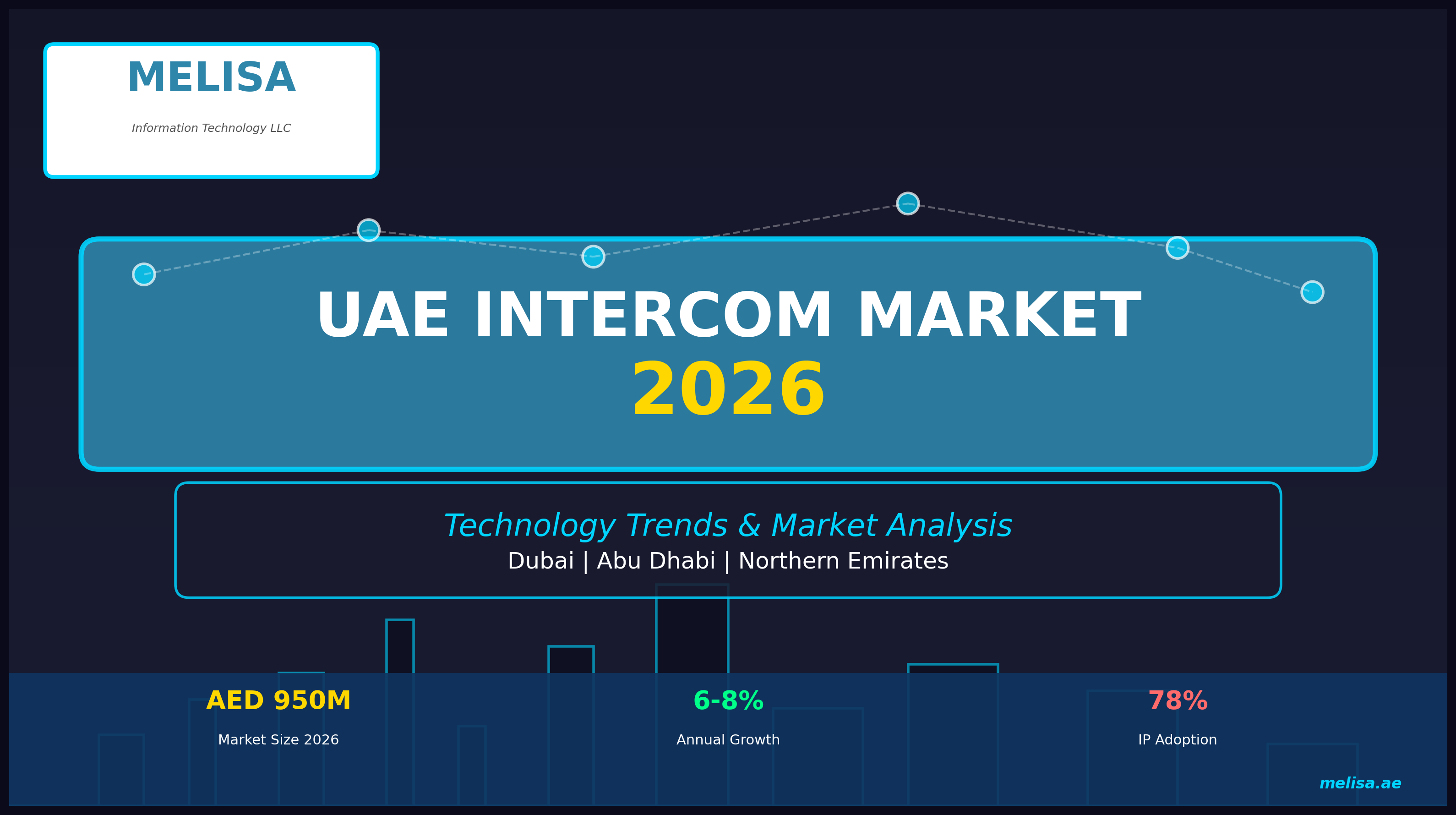
UAE Industrial Communication Market Size 2026
Total Annual Market Value: AED 850M - 1.1B
Segment Breakdown:
Oil & Gas: 45% (AED 380M-495M)
Power & Utilities: 20% (AED 170M-220M)
Manufacturing: 18% (AED 150M-200M)
Transportation: 10% (AED 85M-110M)
Other Industrial: 7% (AED 60M-77M)
Growth Rate: 6-8% annually (2026-2030)
Market Drivers:
New facility construction
Legacy system replacements
Regulatory compliance upgrades
Technology migration (analog to IP)
Technology Adoption Rates
IP-Based Systems: 78% of new installations
Hybrid Cloud: 23% adoption rate
AI-Enhanced Features: 15% of projects
Wireless Integration: 31% include wireless components
Legacy Analog: 22% of new installations (declining)
Regional Project Distribution
Abu Dhabi: 52% of market value
Dubai: 31% of market value
Northern Emirates: 17% of market value
Average Project Values
Small Systems: AED 150K-400K
Medium Systems: AED 600K-1.8M
Large Systems: AED 2.5M-8M
Mega Projects: AED 10M+
About Melisa Information Technology LLC
We've operated in the UAE industrial communication market since 2005, delivering systems for oil and gas facilities, manufacturing plants, and critical infrastructure across the Emirates.
Our engineering team combines expertise in:
Industrial PAGA and intercom systems
IP network infrastructure design
Hazardous area installations
System integration and commissioning
Official UAE Partner for Leading Brands:
Neumann Elektronik (Germany)
Avigilon (Canada/USA)
Motorola Solutions (USA)
Cambium Networks (USA)
SIAE Microelettronica (Italy)
Navtech Radar (UK)
📞 Phone: +971 52 766 4837
📧 Email: info@melisa.ae
🌐 Website: www.melisa.ae
📍 Office: Unit 2201, 22nd Floor
Metropolis Tower, Al Abraj Street
Business Bay, Dubai
United Arab Emirates
Schedule consultations with our engineering team for project-specific guidance.